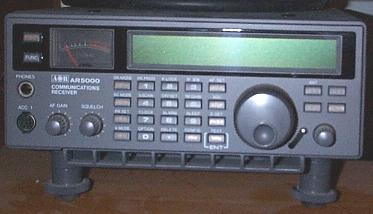
 Full coverage monitoring receiver.
A very good radio, with a good selection of bandwidths and step sizes. Can be computer-controlled and it has a discriminator output on the AUX connector. Also has a 10.7 MHz IF output on the back.
|
|
| After several requests I've put together this page to enumerate the various radios and other equipment that I've got in the shack. |
|
Full coverage monitoring receiver.
A very good radio, with a good selection of bandwidths and step sizes. Can be computer-controlled and it has a discriminator output on the AUX connector. Also has a 10.7 MHz IF output on the back. |
|
Full coverage handheld.
A fairly good performer, although mine could use a speaker mod to eliminate the audio cutting in and out that can occur. |
| This is a radio facsimilie terminal that produces printed copies of radio fax signals, such as satellite weather maps. |
|
Desktop shortwave radio, 10 kHz to 30 MHz.
Like many owners, I'm looking for the Service Manual for this rig. So far all I have are the schematics. |
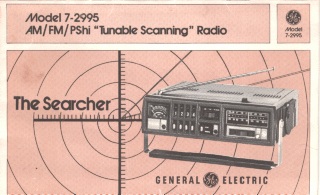 AC or battery-powered desktop radio, with AM, FM and Public Service Band
(PSB).
AC or battery-powered desktop radio, with AM, FM and Public Service Band
(PSB).
Four-channel scanning in the VHF band. |
|
Handheld scanner capable of monitoring Project 25 Phase 1 and Phase 2 systems.
GRE America closed down in 2012 and in September 2013 the intellectual property rights were purchased by the Whistler Group of Bentonville, Arkansas. |
| Portable FM/Medium Wave/Long Wave/Short Wave radio |
|
The Icom PCR-100 is a compact, computer-controlled wideband communications
receiver introduced in the late 1990s that covers approximately 10 kHz to
1300 MHz (with some frequency restrictions depending on market). Unlike a
traditional radio with front-panel controls, the PCR-100 relies entirely
on software running on a connected PC, making it an early example of the
shift toward computer-integrated radio operation. It supports AM, FM,
and wide-FM reception with extensive scanning and memory capabilities,
allowing users to monitor shortwave, amateur radio, aircraft, public
service, and broadcast signals from a single device. Its small size and
broad frequency coverage made it popular among hobbyists and monitoring
enthusiasts, although the lack of SSB reception limited its usefulness
for some shortwave and amateur applications.
I bought one at the 2026 Dayton/Xenia Hamvention.
|
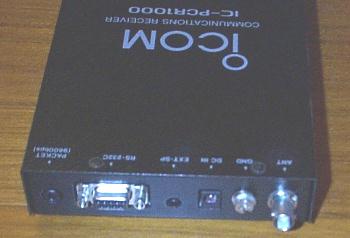 PCR-1000, computer controlled receiver about the size of a
large paperback book. For data decoding fans like me the built-in
discriminator output is nice.
PCR-1000, computer controlled receiver about the size of a
large paperback book. For data decoding fans like me the built-in
discriminator output is nice.
ICOM bungled the release of the control protocol, but it's been reverse-engineered and is available on the Internet. As with any receiver, it's important to have the right antenna for the frequencies you're interested in. I recently purchased a UT-106 DSP Unit and will install it when I have some time. |
|
Very small handheld receiver circa 1989.
After all thesee years the internal battery no longer holds a charge. |
| Very small handheld scanner. |
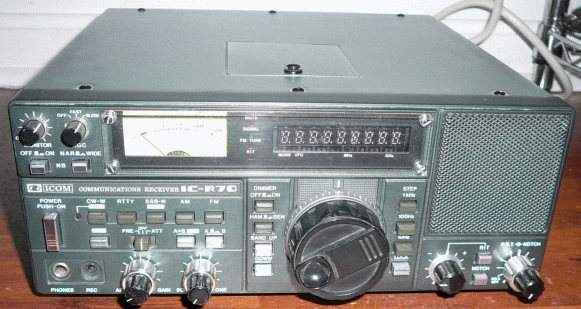 Desktop receiver covering 100 kHz to 30 MHz.
I bought a second unit, in the original box, from a thrift shop.
|
Update: I bought another IC-R7000 at the 2025 Dayton Hamvention.
|
|
Full coverage monitoring receiver. Mine doesn't see that much use
since I got an R8500.
Bought a second unit at the 2018 Hamvention.
|
|
The Icom R71A is a tabletop HF communications receiver introduced in
the mid-1980s and widely regarded as one of the classic general-coverage
shortwave receivers of its era. Covering roughly 100 kHz to 30 MHz, it
receives AM, SSB, CW, and RTTY signals, with optional FM capability,
and uses a sophisticated multi-conversion superheterodyne design for
strong selectivity and resistance to interference. Features such as
passband tuning, an IF notch filter, adjustable noise blanking, dual
VFOs, keypad frequency entry, and memory channels made it attractive to
serious shortwave listeners, amateur radio operators, and DXers. The R71A
developed a reputation for solid sensitivity and excellent weak-signal
performance, and many examples remain in use today despite age-related
issues such as memory battery failures and capacitor aging.
I bought one at the 2026 Dayton/Xenia Hamvention.
|
|
The ICOM R8500 is a wideband all-mode communications receiver introduced
in the mid-1990s as a successor to the ICOM R7000 and R7100. Designed for
professionals, hobbyists, and serious monitoring enthusiasts, the R8500
built upon the legacy of its predecessors by offering broader frequency
coverage, enhanced digital control, and improved signal handling. It
remains one of the most respected tabletop receivers of the late 20th
century.
The ICOM R8500 covers from 0.1 MHz (100 kHz) to 1999.99 MHz (just under 2 GHz), virtually continuous, except for some cellular frequency blocks due to legal restrictions in the U.S. version. It features:
Its front-end is relatively strong, allowing it to perform well in RF-dense environments. Users frequently praised the receiver’s ability to pull in weak signals, especially in the shortwave and VHF/UHF bands. The R8500 was an evolutionary improvement over the R7000 and R7100. It retained the all-mode capability and wide frequency coverage but added:
Compared to the R9000 — ICOM’s high-end receiver of the era — the R8500 was more affordable and somewhat more rugged for field use, though it lacked some of the R9000’s advanced display and IF filtering options. ICOM discontinued the R8500 in the early 2000s, though it remained available from distributors and on the used market for several years after. It was succeeded indirectly by ICOM’s involvement in more SDR (Software Defined Radio) and amateur radio transceivers with wideband receive functions. Despite no longer being manufactured, the R8500 is still widely used and highly respected. Many consider it among the best analog-digital hybrid wideband receivers ever made. Its durable design and high-quality RF performance allow it to remain competitive with more modern digital receivers, especially for those preferring knobs and direct operation over software interfaces.
The "IF OUT" jack on the back panel outputs a 10.7 MHz IF signal with 9 volts DC for external equipment. Update: I bought a second full coverage unit at the 2016 Dayton Hamvention. |
|
R-2000 receiver, with a VHF Converter Unit.
|
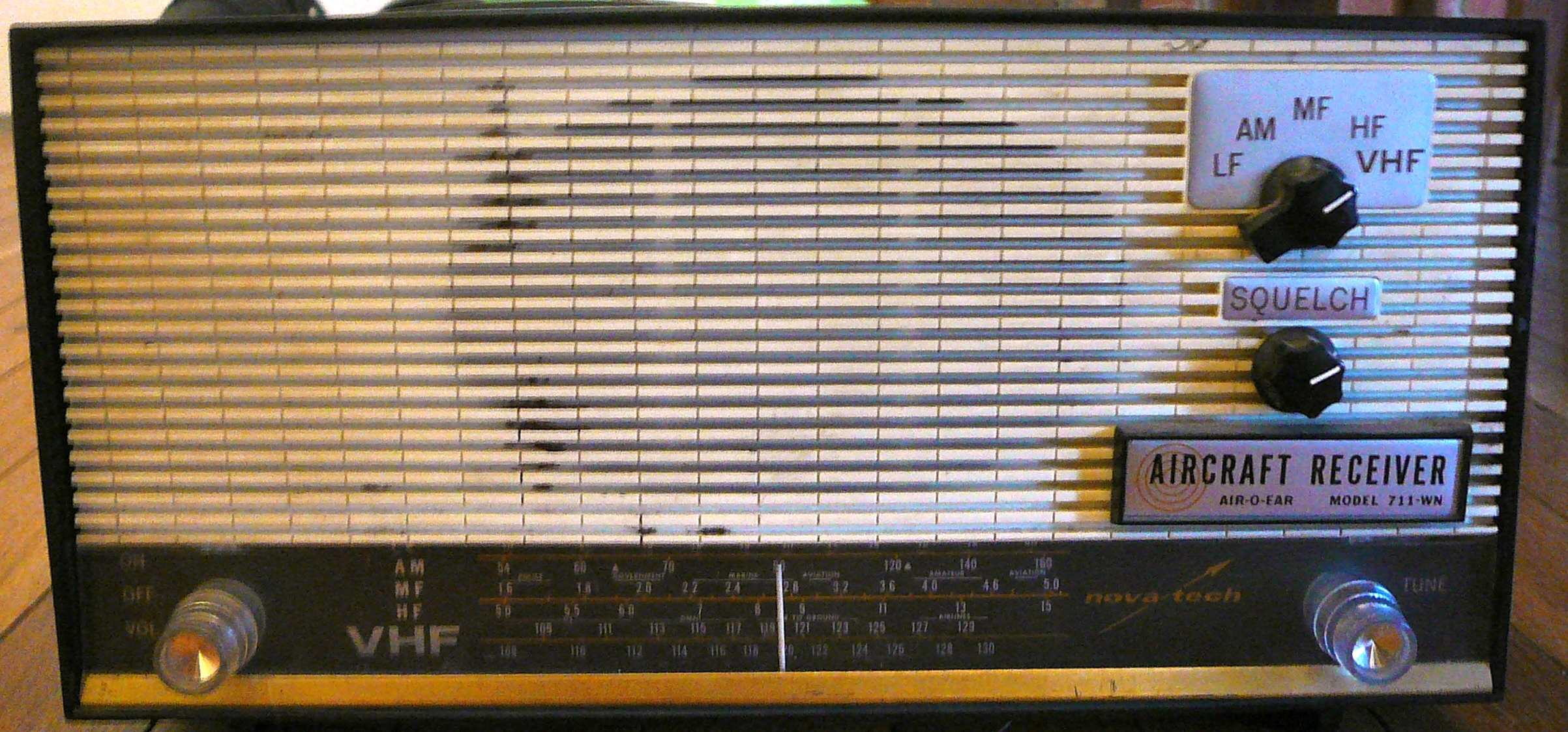
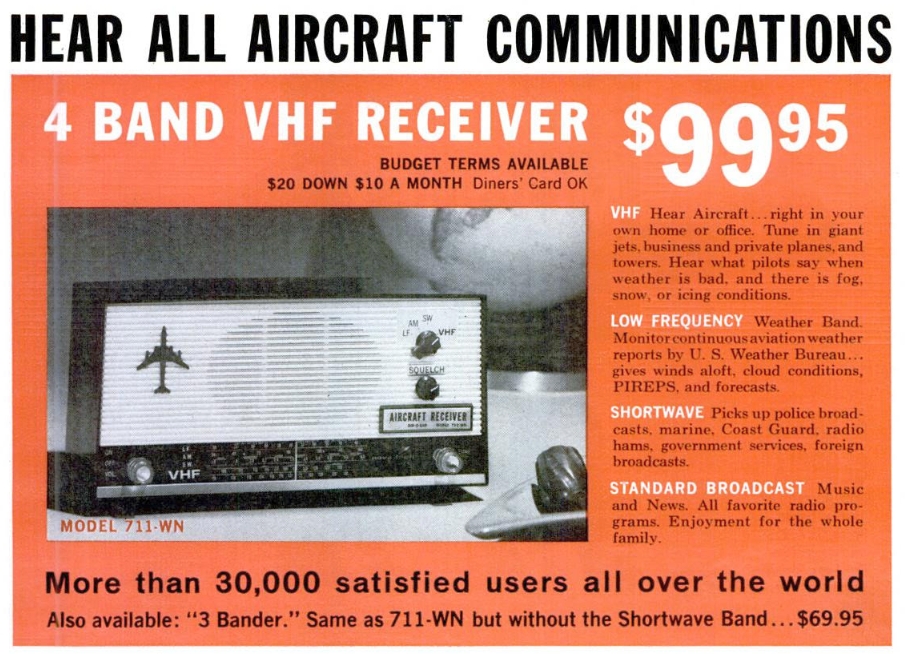 Early 1960's aircraft and shortwave receiver. It was advertised in
the August 1964 issue of Flying magazine, among others.
Early 1960's aircraft and shortwave receiver. It was advertised in
the August 1964 issue of Flying magazine, among others.
I'm looking for SAMS Photofact 659-4, which covers this model. |
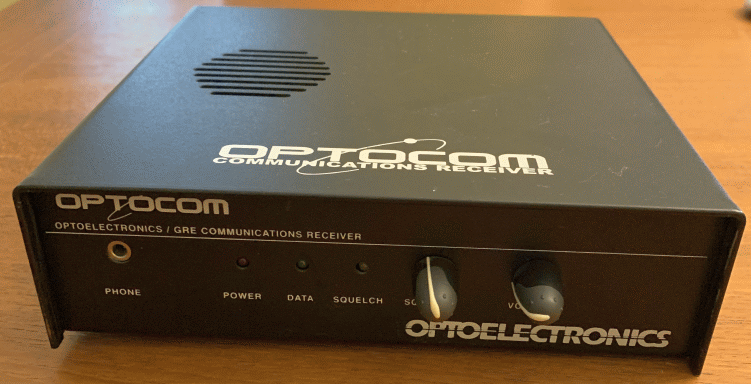 The Optoelectronics Optocom is a computer-controlled scanner based on a
receiver manufactured by GRE that was originally introduced in Radio
Shack's PRO-2035/2042 scanners.
The Optoelectronics Optocom is a computer-controlled scanner based on a
receiver manufactured by GRE that was originally introduced in Radio
Shack's PRO-2035/2042 scanners.
It covers 25 to 520 MHz and 760 to 1300 MHz (less cellular) and can decode CTCSS, DCS and DTMF tones. It can track analog Motorola, EDACS and LTR trunked systems and can scan up to 100 channels per second. For monitoring data systems that use frequency shift keying (FSK), the receiver has a built-in data slicer. The Optocom uses a modified version of the Optoscan OS-535 interface with a documented application programming interface (API). Unfortunately, it's discontinued. It's a neat design -- a GRE receiver board interfaced to a computer-control board (controlled via a Winbond 8051 microprocessor). Opto had planned to offer a series of add-ons to the receiver, but eventually had trouble getting boards from GRE in the small quantities that sales numbers dictated. I purchased one at the 2024 Dayton Hamvention.
|
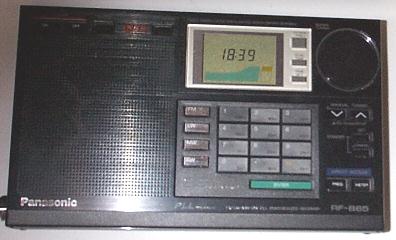 Portable AM/FM/Shortwave receiver. This was purchased from
a thrift store and works fine.
Portable AM/FM/Shortwave receiver. This was purchased from
a thrift store and works fine.
|
|
Desktop scanner purchased at the 2018 Hamvention.
Eight memories. Coverage from 30 to 50 MHz, 144 to 174 MHz and 450 to 512 MHz. I don't have a user manual, but these are from a forum posting back in 2005:
|
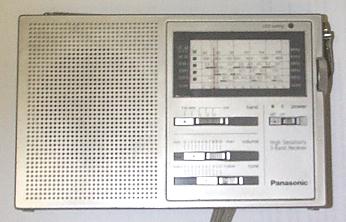 Portable AM/FM/Shortwave receiver.
|
|
Portable AM/FM/SW receiver.
Very good sound from this receiver. |
|
Portable AM/FM/PSB receiver.
Coverage is 525-1605 KHz (AM), 87.5-108 MHz (FM), and 148-174 MHz (PSB). This radio is still in the original box. |
| Small, handheld AM/FM/shortwave receiver. |
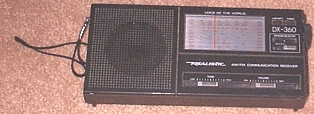 Portable AM/FM/shortwave receiver.
I have two of these units.
|
|
Portable AM/FM/Shortwave receiver.
Support documents can be found on Radio Shack's support web site, here.
|
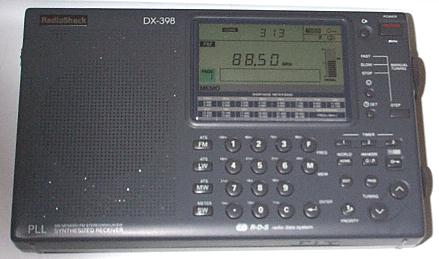 Portable AM/FM/Shortwave receiver.
Support documents, including a manual in Adobe Acrobat (PDF) format, can be found on Radio Shack's support web site, here. This radio is identical to the Sangean ATS-909. |
|
Portable shortwave receiver, Radio Shack 20-207.
Missing the smaller backup battery door. |
|
|
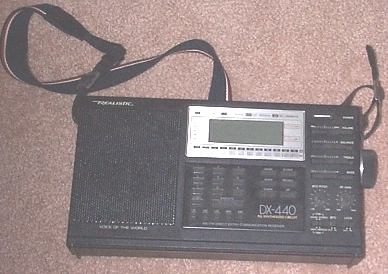 Portable shortwave receiver.
|
|
|
| Handheld, APCO Project 25 trunk-tracking scanner. |
| Early programmable base/mobile scanner. |
GRE-designed and built handheld TrunkTracking scanner.
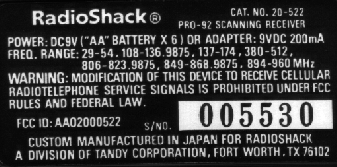
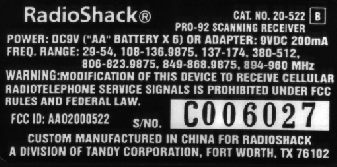 I have the first version and the B model
(note the 'B' inside the box in the upper right corner of
the right-hand photo).
I have the first version and the B model
(note the 'B' inside the box in the upper right corner of
the right-hand photo).
I have a little more information about this scanner here. |
|
1000-channel dual-trunking handheld scanner.
|
|
|
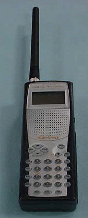 GRE-built digital (APCO-25) trunk tracking portable scanner.
I have more information about this scanner here.
|
|
|
|
Desktop shortwave receiver circa 1980 - 1984.
Covers 550 kHz to 30 MHz. |
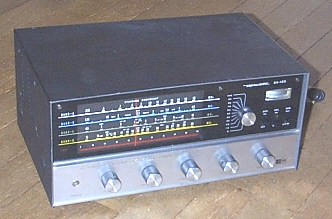 Early 1970's basic shortwave receiver.
For more information and photographs, click here. |
|
|
The Realistic DX-150 is a classic tabletop shortwave radio receiver that
was sold by Radio Shack, a retail electronics chain operated by Tandy
Corporation, during the late 1960s and early 1970s. It became one of
the most recognizable and accessible shortwave receivers for hobbyists
in North America during that era. Known for its distinctive analog dial,
large form factor, and solid performance for its price, the DX-150 helped
introduce thousands of listeners to the world of shortwave radio.
The DX-150 was first introduced around 1967 under Radio Shack’s
Realistic brand. Manufactured in Japan by General Research of
Electronics (GRE), the DX-150 was targeted at amateur radio enthusiasts
and casual shortwave listeners. The original DX-150 was quickly followed
by incremental improvements, culminating in several versions:
The Realistic DX-150 was a solid-state receiver, a major step forward from earlier vacuum tube-based designs. It featured:
The DX-150 offered a good balance of usability and price, and while it wasn’t the most precise receiver in its class, its robust build and simple controls made it popular with both novices and experienced DXers. Performance-wise, the DX-150 series provided respectable sensitivity and selectivity for its time, especially in the AM broadcast and lower shortwave bands. However, it had limitations when it came to SSB reception, as it lacked a true BFO (Beat Frequency Oscillator). Some later models, like the DX-160 (a direct successor), included better SSB capabilities. Despite these constraints, it was well-loved for picking up major international broadcasters like Radio Moscow, BBC World Service, Voice of America, Radio Havana Cuba and Deutsche Welle. I remember using one in the mid-1970s to listen to WWV. The DX-150 holds an important place in shortwave radio history, particularly in the United States. During its time, there were few ways to hear unfiltered foreign news and cultural programming. The DX-150 gave everyday people access to a global spectrum of voices, making it more than just a technical device — it was a window to the world during a time of geopolitical tension and change. Its widespread availability in the U.S., through Radio Shack’s massive retail network and popular mail-order catalog, helped democratize shortwave listening. Many ham radio operators, military personnel, and curious teens from the 1960s and 70s got their start with a DX-150 sitting on their bedroom desk. Late 1960's vintage GRE-built shortwave receiver. You can read more about this model here. |
| Early 1970's vintage GRE-built shortwave receiver. |
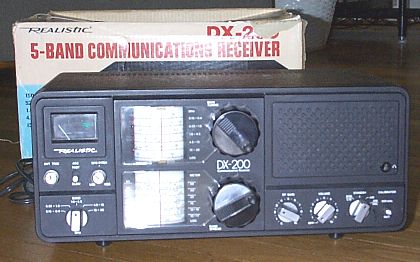 Five-band shortwave receiver.
For more information and photographs, click here. |
|
Portable-band shortwave receiver.
"Voice of the World" FM/FM STEREO/LW/MW/SHORT WAVE/PLL SYNTHESIZED RECEIVER
|
|
Portable-band shortwave receiver.
Catalog number 20-213A FM/MW/SW 1-10 12 BAND PORTABLE RECEIVER
|
|
4-channel crystal-controlled VHF handheld scanner approved by the FCC
in 1982.
Coverage: 118-136 MHz and 144-148 MHz. |
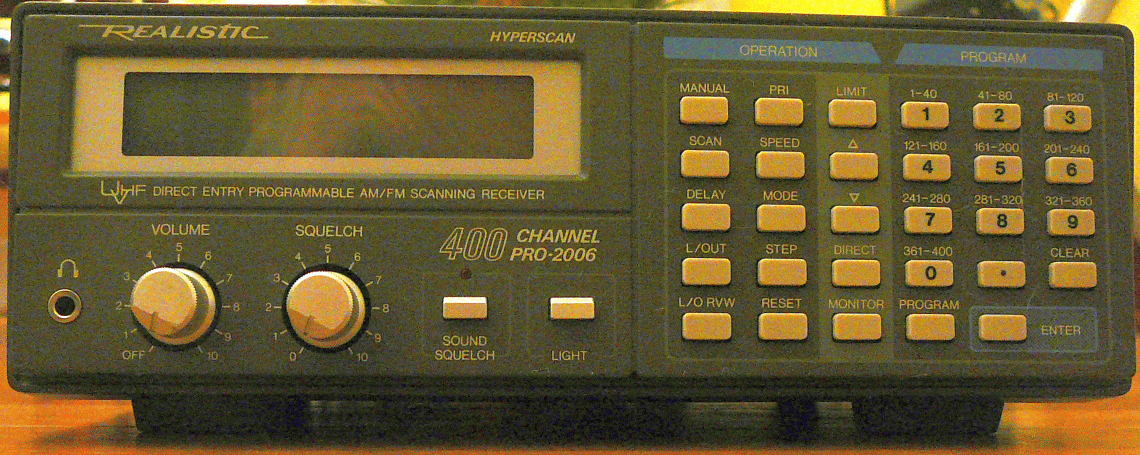 400-channel desktop scanner manufactured by GRE.
Coverage: 25-520 MHz, 760-823.945 MHz, 851-868.945 MHz, 896-1300 MHz The gaps in 800 MHz coverage are due to the 1986 Electronic Communications Privacy Act (ECPA) which mandated that the FCC deny certification to scanners that could tune to these (at the time) analog cellular telephone frequencies. Coverage could be restored by clipping a particular diode. A quick guide to operations is available here.
|
|
8-channel VHF/UHF desktop scanner manufactured by GRE circa 1995.
Coverage: 29-50 MHz, 144-148 MHz, and 410-512 MHz. |
| Twenty-channel programmable base/mobile scanner built by GRE covering frequencies in the VHF and UHF bands. |
|
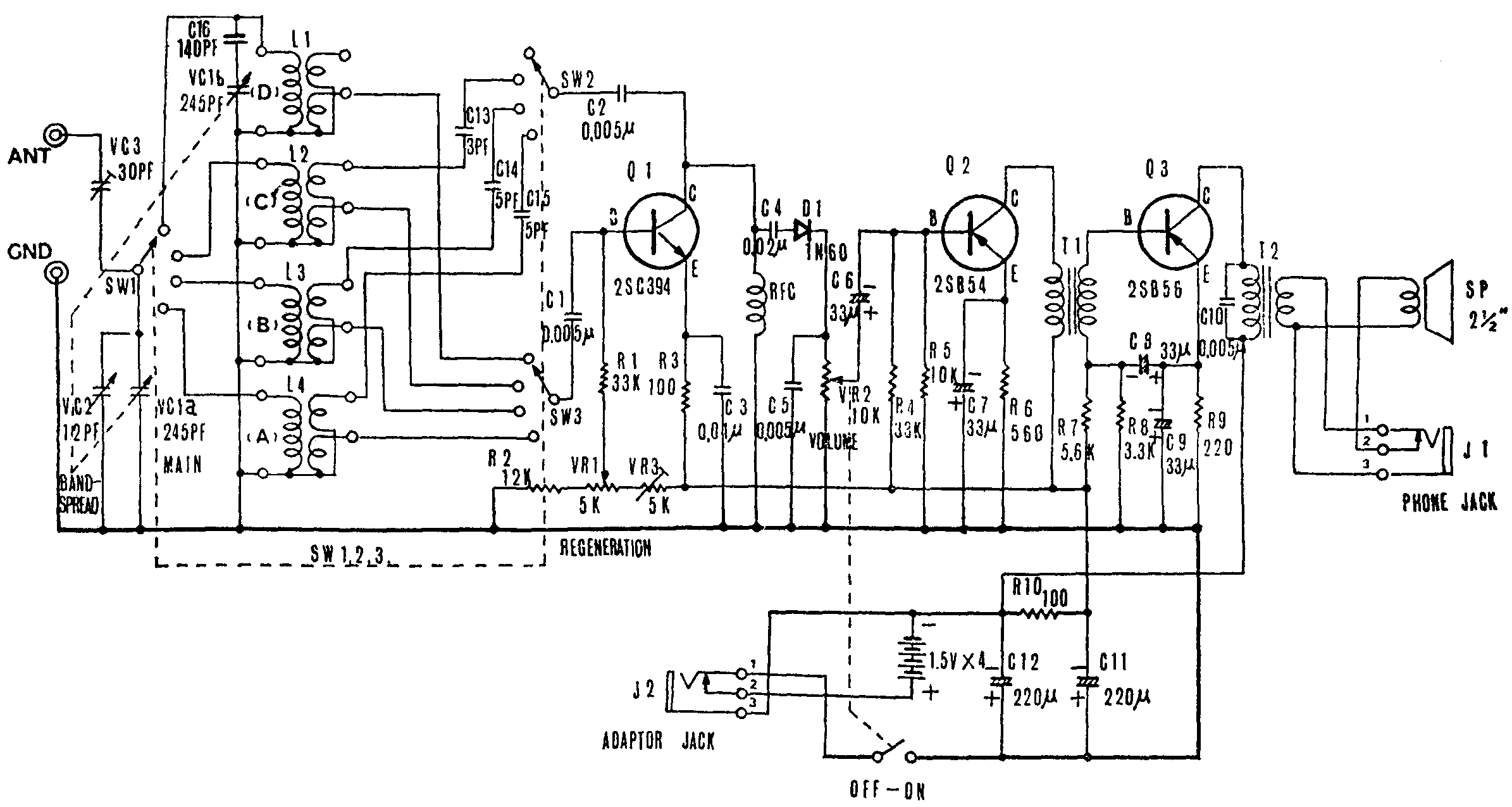
Basic shortwave receiver that covers four bands from 550 kHz through 30 MHz
with a separate bandspread selector.
A schematic and manual can be found here. A local copy of the schematic (click for a larger image):
|
 A portable shortwave receiver.
Click here for more photos. |
This is a Radio Direction Finiding (RDF) three-band marine receiver. It covers:
|
|
|
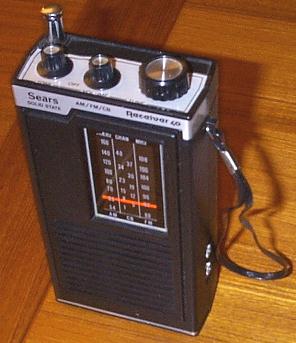 I know 11 meters isn't everyone's favorite band, but
I thought this radio was interesting enough to pick up.
It's an AM/FM/CB monitor with analog tuning, allowing the
user to hear any potential interstitial transmissions.
It also works well for receiving the audio from cheap wireless microphones.
I know 11 meters isn't everyone's favorite band, but
I thought this radio was interesting enough to pick up.
It's an AM/FM/CB monitor with analog tuning, allowing the
user to hear any potential interstitial transmissions.
It also works well for receiving the audio from cheap wireless microphones.
|
|
|
| Portable FM/Long Wave/Medium Wave/Short Wave radio |
|
|
|
The Ten-Tec RX-320 is a compact computer-controlled HF communications
receiver introduced in 1998 that covers approximately 100 kHz to 30
MHz and was designed around an early hybrid DSP architecture. Unlike
conventional tabletop receivers, the RX-320 is essentially a “black
box” with almost no front-panel controls, relying on a PC connected
through an RS-232 serial interface for all tuning and operation. It
receives AM, USB, LSB, and CW signals and includes numerous DSP-selectable
IF bandwidths, spectrum display capability, extensive memory functions,
and software-based tuning features that were advanced for its price
range. The receiver earned a reputation for delivering strong shortwave
performance and good value at relatively low cost, although dependence
on a computer and lack of standalone operation made it less appealing
to users who preferred traditional radio controls.
I bought a second unit at the 2026 Dayton/Xenia Hamvention. |
|
|
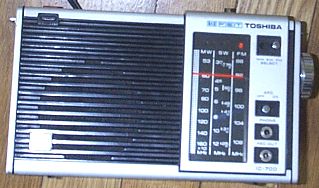
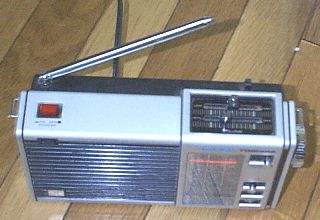 I picked up this three-band portable receiver at a local hamfest.
The end of the telescoping antenna is missing, but it doesn't affect
the operation of the radio.
I picked up this three-band portable receiver at a local hamfest.
The end of the telescoping antenna is missing, but it doesn't affect
the operation of the radio.
This model originally came out around 1971. |
|
|
|
Bearcat Five-Six.
Handheld five-band, six-channel crystal-controlled scanner. Covers the following bands: 33-47, 118-136, 154-164 and 450-512 MHz.
|
|
|
|
Bearcat 100XLT.
VHF/UHF handheld scanner. |
|
|
|
Bearcat 125AT.
VHF/UHF handheld scanner. |
|
|
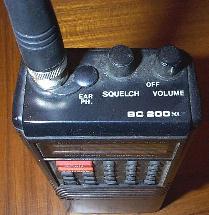 Bearcat 200XLT.
UHF, VHF, 800 MHz coverage (less cellular) handheld scanner.
|
|
|
| Older desktop scanner. |
|
|
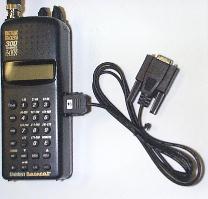 Bearcat 245XLT.
Full coverage (less cellular) TrunkTracking handheld scanner. Capable of computer control. |
|
|
|
16-channel base/mobile scanner with 'one touch' weather button. Covers 10 bands
with the following frequency bands:
29 to 54 MHz, 137 to 174 MHz, and 406 to 512 MHz.
I bought this unit at a garage sale. When I plugged it in, instead of channel numbers, the two-digit display showed 'L'. I hit the [WX] button and immediately heard the local NOAA weather radio transmission. Hitting [SCAN] after that caused the scanner to run through all sixteen channels. Apparently there are folks out there who get the 'L' display and are unable to proceed. If the [WX] doesn't work, try programming one of the 16 channels with a known frequency (NOAA weather frequencies are good for this: try 162.400 and 162.550 first). After receiving a good signal, manually step thorugh each channel - you should hear static if the squelch is set correctly.
|
|
|
|
Desktop receiver covering 200 kHz to 29.90 MHz.
|
|
|
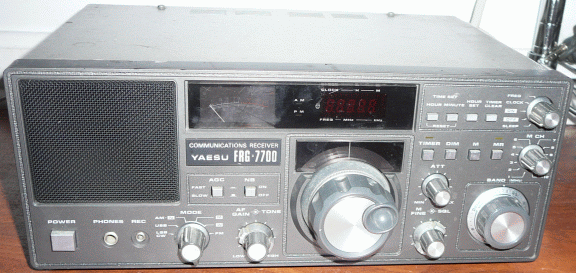 Desktop receiver covering 150 kHz to 30 MHz.
Serial number format: YM PPPSSS, where Y is production year in the 1980's (e.g. '4' = 1984), M is the productiom month (e.g. 'E' = May), PPP is the production run and SSS is the individual serial number. The letter 'M' preceeding the serial number indicates the factory installation of a memory module. |
|
|
The Yaesu FT-65 is a compact, dual-band handheld transceiver designed
for amateur radio operators. Manufactured by Yaesu Musen Co., Ltd., a
Japanese manufactre, the FT-65 delivers communication capability in both
the VHF (2 meters, 144–148 MHz) and UHF (70 centimeters, 430–450 MHz)
amateur bands.
While the FT-65 can be manually programmed via the keypad, most users prefer to use programming software like CHIRP (free, open-source) or Yaesu’s own PC programming suite. A programming cable is required. Handheld dual-band transceiver. |
|
|
|
The Yaesu VR-5000 is a wideband all-mode communications receiver
released in the early 2000s by Yaesu Musen Co., Ltd.
Following the success of earlier Yaesu models like the VR-500 (a
handheld wideband receiver), the VR-5000 was introduced as a desktop
version with expanded capabilities, more robust performance, and deeper
feature integration.
This radio was released under both the Yaesu and Vertex Standard brands, depending on region and time of sale. It was marketed as a compact but powerful base receiver that could fit easily into a desktop shack while offering serious performance. The Yaesu VR-5000 offers:
Yaesu discontinued the VR-5000 in the mid-2010s, as wideband software-defined receivers (SDRs) such as the SDRplay, Airspy, and ICOM IC-R8600 began to dominate the market with better performance, digital decoding, and higher dynamic range at similar or lower cost. Desktop receiver covering 10 kHz to 2.6 GHz (less cellular) with a 10.7 MHz IF output. This particular unit was manufactured in 2008. I'm looking for computer control and cloning commands beyond the few CAT messages described in the manual. |
|
|
|
Yupiteru MVT7100 full coverage handheld scanner.
I bought a second one at the 2016 Dayton Hamvention. |
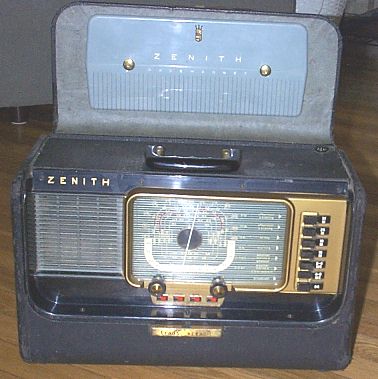 The H500 model was introduced by Zenith Radio Corporation in 1951, as
part of the company's long-running Trans-Oceanic series, which had its
origins during World War II. The Trans-Oceanic line began with the 7G605
"Clipper" in 1942, which was created at the personal direction of Zenith
founder Eugene F. McDonald Jr., a world traveler and naval reserve
officer who wanted a portable radio that could receive international
broadcasts anywhere.
The H500 model was introduced by Zenith Radio Corporation in 1951, as
part of the company's long-running Trans-Oceanic series, which had its
origins during World War II. The Trans-Oceanic line began with the 7G605
"Clipper" in 1942, which was created at the personal direction of Zenith
founder Eugene F. McDonald Jr., a world traveler and naval reserve
officer who wanted a portable radio that could receive international
broadcasts anywhere.
After WWII, Zenith continued to develop this line, releasing increasingly refined models. The H500 replaced the earlier G500 (1949–1951) and was followed by the 600 series (starting in 1954). The H500 Trans-Oceanic was a portable vacuum tube multiband receiver with coverage of standard AM (broadcast band) and several shortwave bands, enabling reception of international and maritime broadcasts. The H500 used 5 vacuum tubes, including miniature types such as 1U4 and 1L6, which were favored for their low power consumption and compact size. The H500 received the AM broadcast band plus five shortwave bands (from roughly 1.6 to 18 MHz), divided into labeled world bands to assist travelers and hobbyists. It includes a telescoping whip antenna and an internal loop antenna for AM reception. It operated on both AC and battery power. The battery was a combined "A" and "B" supply, often difficult to replace today. It featured a black leatherette-covered steel case with a front-opening door, giving it the look of a briefcase or luggage—a deliberate styling choice for travel appeal. A removable **Wavemagnet** loop antenna could be used for directional AM reception and attached to windows in hotel rooms for better reception. The H500 included simple but durable tuning and volume controls, a band selector switch, and a flip-up world time zone chart to help users calculate local time in various countries—highlighting its international focus. The H500 marked the end of an era as it was the last major Trans-Oceanic model based entirely on vacuum tube technology before the line transitioned to hybrid and then all-transistor designs. It was produced from 1951 to 1954, after which it was succeeded by the 600 series, which included the L600, R600, and B600, all of which refined the design but kept the same general aesthetic. Vacuum tube shortwave radio, model H500. I need to get a spare set of tubes for this unit. Does anyone have a good source for tubes, especially the 1L6, that aren't at a ridiculous price? |
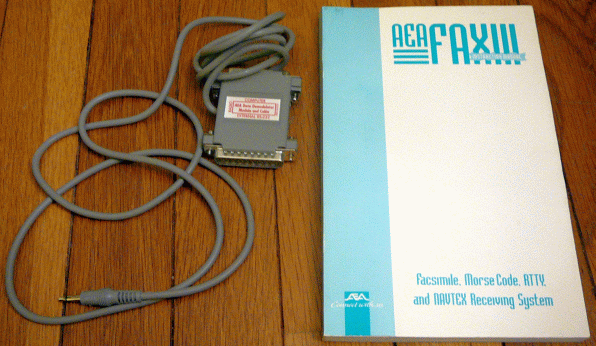 From the manual:
The worse the weather gets, the better AEA FAX III is. This is because AEA FAX III allows you to colorize your received WeFax images, producing amazing full-color weather displays. Note: Timewave Technology Inc. acquired the AEA data products line in April, 1997.
|
|
|
 From the manual:
The KT-2 has two basic modes of operation. You may choose between a keyer and a Morse trainer. Control for each mode is provided from the keypad for full feature programming.
|
|
|
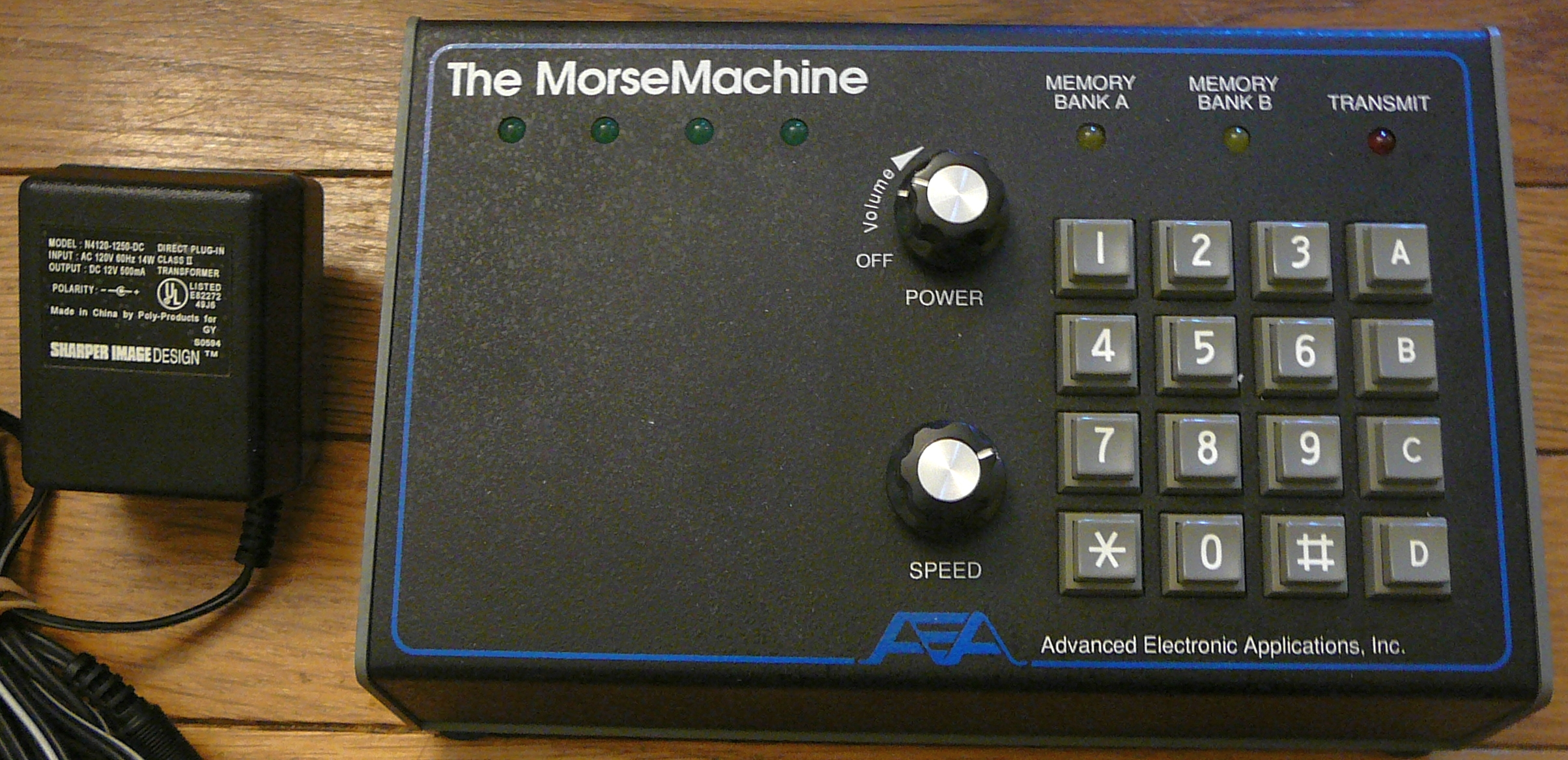 From the manual:
The Morse Machine is a full-featured, high performance keyer featuring 2-255 WPM programmable or 2-99 WPM variable speed selection and 8,000 memory characters that can be stored into 20 memories (36,500 characters if 32K RAM is used. See page 4). Seven programmable modes of operation are included: KEYER/MEMO- RY SEND, BEACON (to automatically repeat a Morse or RS-232 ASCII message at a programmed interval of one to 999 seconds), MEMORY LOAD, TRAINER (allows random code group practice at steadily increasing speeds), MORSE TERMINAL, CONTEST SIMULATOR and QSO SIMULATOR.
A computer serial port can be interfaced to The Morse Machine through its RS-232 compatible I/O allowing any front panel function to be programmed from the computer. Loading memories is as simple as typing them on the computer keyboard. Further, your random code, contest or practice sessions can be displayed on your computer screen.
|
|
|
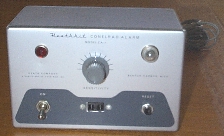 A relatively scarce Cold War device designed to prevent accidental
transmissions that might guide Soviet missiles. You can read more
about it
here.
A relatively scarce Cold War device designed to prevent accidental
transmissions that might guide Soviet missiles. You can read more
about it
here.
|
|
|
| Two antenna, two receiver impedence matcher. |
|
Noise reduction via Digital Signal Processing.
Brief documentation is available from Radio Shack's support web site at here. The September 1998 Hints newsletter from the American Radio Relay League (ARRL) has the following modification:
Louder DSP with the RS 21-543 Box
|
| Need recap and realignment. |
|
|
| Two radios. Need recap and realignment. |
|
|
| Need replacement battery. |
|
|
|
MFJ-872 SWR Meter, 1.8 to 200 MHz (~$114)
MFJ-891 Giant X Wattmeter, 1.6 to 60 MHz (~$195) |
Click here for the Main page.
Last revised May 17, 2026
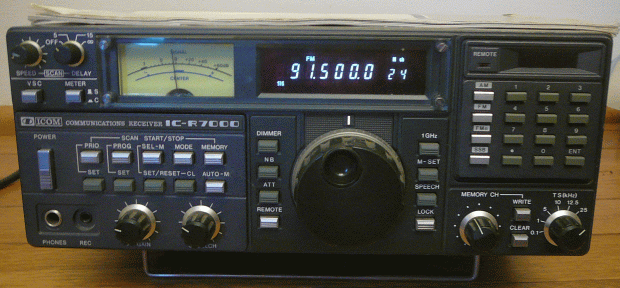 Full coverage monitoring receiver.
I purchased this unit used at the 2017 Dayton Hamvention.
Full coverage monitoring receiver.
I purchased this unit used at the 2017 Dayton Hamvention.
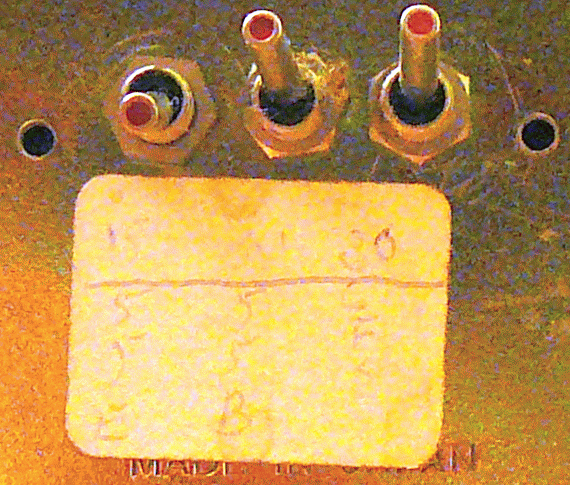
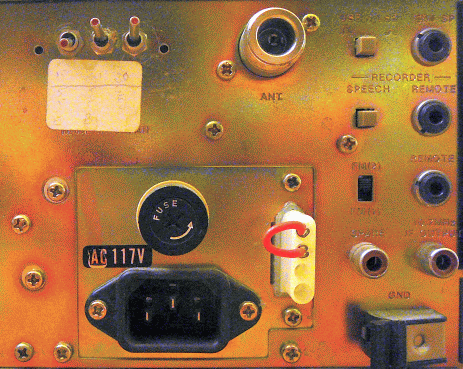 It has a set of modifications; three
subminiature switches mounted on the back panel.
It has a set of modifications; three
subminiature switches mounted on the back panel.
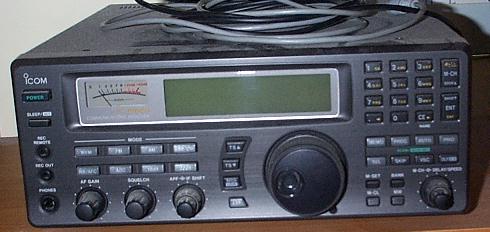 Full coverage monitoring receiver. The successor to the
R7100. Solid performance, built-in discriminator output and
10.7 MHz IF output.
Full coverage monitoring receiver. The successor to the
R7100. Solid performance, built-in discriminator output and
10.7 MHz IF output.