|
|

|
CONTENTS
- Project 25 Systems
The
Project 25 Technology Interest Group (PTIG)
maintains lists of known P25 systems. Note that these lists
are in Portable Document Format (PDF).
- The list of conventional P25 systems as of March 2017 is here.
- The list of trunked P25 systems as of May 2017 is here.
- National Interoperability
Click here for the
Interoperable Communications Technical Assistance Program. The page has a link to download
the latest National Interoperability Field Operations Guide (NIFOG).
- FEMA Fire Service Guide
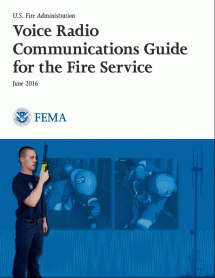
Click on the image to download a PDF of Voice Radio Communications Guide for the Fire Service
dated June 2016.
- Trunked Radio
I've written two introductory articles on how trunked radio works.
You can read them
here
and
here.
- Monitoring TETRA
An excellent tutorial on using a small, inexpensive software defined radio
and Osmo-TETRA software to monitor Terrestrial Trunked Radio (TETRA)
systems can be found here.
- Digital Speech Decoding
Computer-savvy hobbyists may wish to experiment with using computer software to monitor digital radio signals. A popular
package currently under development is Digital Speech Decoder (DSD).
Download DSD and mpelib from this page.
A good tutorial is available here.
DSD requires an additional software package called Cygwin DLL that can be found
here. Download and install the 32-bit version.
Copy the cygwin1.dll file into the DSD directory.
A basic introduction for Windows users is available here.
- Digital Speech Decoding Plus
An enhanced and somewhat more capable version of DSD appeared in December 2013, designed to operate under Windows.
Download DSD+
DSD+ requires the use of an audio software package that can encode MP3 audio files.
Go here
to download an installation program. Run it and move the lame_enc.dll file
to the DSD+ directory.
- DMR Decode
A free and open source decoder for Digital Mobile Radio (DMR) is available
here.
Source code can be found here.
- APCO Project 25 Security
- Researchers based at the University of Pennsylvania have published an academic
paper describing some security weaknesses in P25. You can read the paper
(in PDF format)
here (local copy
here).
- A research group in Australia have analyzed the implementation of various
encryption-related functions in Project 25. Their research paper is
here
(local copy here).
- APCO P-25 Scanners
Monitoring APCO Project 25 systems requires a digital-capable scanner.
-
Uniden is selling the SDS100 handheld and SDS200 base/mobile
scanners. Both are capable of monitoring P25 Phase 1 and Phase 2 systems and
are the first consumer-grade scanners based on software-defined radio (SDR)
technology.
- The Whistler Group is selling the TRX-1 handheld and
TRX-2 base/mobile scanners. These models are capable of monitoring
P25 Phase I and Phase II as well as DMR, MotoTRBO and NXDN transmissions.
- Uniden is selling the BCD436HP handheld and BCD536HP base/mobile
scanners. These units are capable of monitoring P-25 Phase I and Phase II
systems and support Zip Code-based scanning, making programming quite easy.
- GRE is selling the PRO-18 scanner,
which requires no user programming. Instead, the user manipulates
a simple, iPod-like front panel interface.
Radio Shack is selling the PRO-18 scanner,
a slightly less capable version of the GRE PSR-800.
- Uniden is selling the HomePatrol-1 scanner,
which requires no user programming. Scanning is based on the
entered zip code of the user.
- Uniden is selling the BC396XT scanner,
which appears to be similar to the BC396T with the addition of
several features, including a bandscope, control channel data output,
GPS location-based scanning and the ability to track
systems that use ESK.
- Radio Shack is selling the PRO-106 and PRO-197 scanners,
which are nearly identical to the GRE PSR-500 and PSR-600 models.
- GRE is selling the PSR-500 and PSR-600 scanners,
capable of tracking APCO Project 25 systems (as well as other analog
trunked systems).
- Uniden is selling the BCD996T, a base or mobile
scanner capable of tracking nearly all APCO P-25 systems, as well
as the common analog trunked systems. It has a unique capability of
accepting external GPS position information and selecting
appropriate frequencies to scan.
More here.
- Uniden is selling the BCD396T, a compact handheld
scanner capable of tracking nearly all APCO P-25 systems, as well
as analog trunked systems.
More here.
-
Radio Shack is selling the PRO-96, a GRE-built scanner
capable of monitoring 3600-baud and 9600-baud trunked APCO P-25
systems.
More here.
-
Uniden is selling upgraded digital scanners, the
BC296D handheld and the BC796D base/mobile scanners.
Each
is capable of monitoring APCO P-25 systems, including those
with 9600 baud control channels.
More here.
-
Uniden continues to sell the
BC250D handheld and the BC785D base/mobile scanners, each
of which are capable of monitoring (some) APCO P-25 systems through
the use of a plug-in BCi25D decoder card.
More here.
- APCO P-25 Decoders
-
AOR is selling the ARD25, an APCO P-25 decoder that uses the 10.7 MHz IF
output of a separate receiver.
More here.
- NOAA Weather Radio
- Decibels
Rhone & Schwartz has an excellent document, dB or not dB?, describing the fundamentals of
the Decibel unit of measurement that is available
here.
- Signal Propagation
- Propagation environment information from a variety of sources can be found
here.
- NOAA maintains the Space Environment Center.
- Information about the Sun-Earth environment at
SpaceWeather.com.
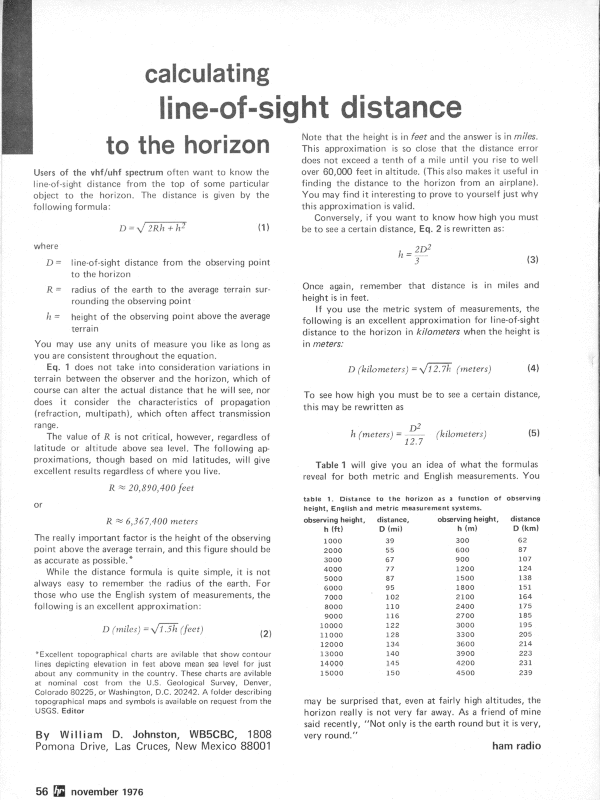
- Ham Radio magazine published a brief article on calculating
line-of-sight distance. You can see a scan of that article by clicking
here.
- Radio Teletype (RTTY)
- Real RTTY signals may once again be on the air, originating from
California (read about the station
here).
From an announcement Dated October 31, 2006:
KSM, the coast station of the Maritime Radio Historical Society (MRHS),
has been granted two RTTY frequencies by the FCC.
The frequencies, known officially as narrow band direct printing (NBDP) channels, are:
8.4330 Mc
12.6310 Mc
Authorized power is 5kW.
The MRHS will use these channels for broadcasting weather, press and other information to the maritime community using RTTY (Baudot) and SITOR FEC modes.
It will take a while for the MRHS Transmitter Department to bring transmitters on line for these frequencies. But now that we have FCC approval we can begin work on this new project. An announcement will be made when we are ready to begin transmission on these frequencies.
VY 73,
Richard Dillman
Chief Operator, KSM
You can read more about the Maritime Radio Historical Society
here.
- Illinois
- As of 2003, "inadvertent" interception of cellular telephone calls is not illegal,
at least according to the State Supreme Court.
Read the reasoning
here.
- Michigan
- Information regarding the permit that used to be required for scanning from
a vehicle in Michigan is available
here.
- If you're interested in where the towers are located in Michigan's statewide
APCO 25 system, click
here.
- Odds and Ends
- Some notes on the origin of "73" and other numeric codes
can be found
here.
- Does anyone know where I can order a
McElroy Chart of Codes and Signals as pictured
here?
-
You can read about maritime Automatic Identification System (AIS) equipment
and signals
here.
- Back in 1970 the magazine Popular Electronics published
this article about detecting
changes in local gravity using a CW receiver.
- Information about building a quadrifilar helicoidal antenna
can be found
here.
- Does anyone know when Motorola built a portable AM/FM
radio with a model number of X70E? Some photos of the radio
can be seen
here.
- Rich Carlson, N9JIG, reviews three scanning magazines
(Popular Communications, Monitoring Times, and
Scanning USA) on his website
here.
- Interoperability
- Spectrum Charts
|